Tuesday, August 12, 2008

Art Every Wednesday (14)

How we experience art is constantly changing. With new technology comes mass production and access. Art evolved through pigments, oils, pastels, water colors, tempera, and photoshop. Story telling and the written word advanced with the innovation of cuneiform, to ink, papyrus, and the printing press. Music metamorphosed with instruments, from the lyre, to the harpsichord, piano, synthesizer, record, tape, CD, and iPod.

Technology changes the way we see art, and the greatest advancement in the mass production and availability of art found its feet in the last 10 years, the world wide web. Let's take a look at how the internet is changing the accessibility and medium of all art-forms.

Photography
Although Photography is relatively new art-form, the digital age transformed it more than possibly any form (outside of music). Check out this TED talk by Frans Lanting, who combines photography, music, and the oral tradition to tell the history of the world.


Poetry
Billy Collins, former United States Poet Laureate, produced a series of youtube.com videos combining his spoken poetry, with powerful images. They furnish his potent verses with a new layer of complex depth.


Sculpture
When Michelangelo sculpted David from cold, harsh stone, he probably never imagined that sculptures centuries later would make kinetic, moving sculptures from wood, powered by wind. Theo Jansen did just this, with the creation of his "beach beasts," seen and described on numerous youtube.com videos.


Architecture
The art of building changes as readily as any professional field. In the following video Reed Kroloff discusses two dueling styles of architecture in culture today, both powered by recent technology evolution. The internet offers users a unique way to interact with, and watch how this technology works.


Music
Most people know how the web transformed the music industry, from Napster to iTunes, most Americans under 30 downloaded a song or two in the last half-decade. Instead of focusing on what most of us know of or participate in, I thought we should take a look at the stranger side of the internet and music. An interactive massive multi-player online game, called second life allows people to create imaginary identities in vast complex worlds, called "islands." A small group of players fashioned their characters after the hit rock group u2, and held numerous in-game concerts. Keep in mind normal people, not game creators, put these concerts on.


Storytelling
After the invention of the printing press oral transmission of stories lost steam. The fine art was limited, but the recorded and reprinted word was limitless. Epic poems filled pages, not ears, but it seems the internet may bring back the old art form. Today hundreds of thousands of bloggers post videos, sharing their hearts and stories, marking the reemergence of the oral tradition.
The beauty of art transforms with culture. With profound excitement, lets transform alongside.

Friday, August 8, 2008

Free Audio: St. Augustine's Confessions

The ChristianAudio.com free audio book of the month is St. Augustine's classic "Confessions". Download it here.

Quotes from the book:

“The greatest source of repair and restoration was the solace of friends… to make conversation, to share a joke, to perform mutual acts of kindness, to read together well-written books, to disagree without animosity, to teach each other something or to learn from one another, to long with impatience for those absent, to welcome them with gladness on their arrival. These and other things come through the heart of those who love and are loved…”

"Wherever the human soul turns to other than to you, it is fixed in sorrows, even if it is fixed upon beautiful things external to you…”

“Let those transient things be the ground on which my soul praises you, but let it not become stuck in them… for the soul loves to be in them and take its repose among the objects of its love.”

Wednesday, August 6, 2008

Art Every Wednesday (13)

Makoto Fujimura


"Shalom"


Fujimura made this piece shortly before the towers fell on 9/11, reflecting on the piece the morning after 9/11 he wrote this in an email to a friend:
"Create we must do, and respond to this dark hour. The world needs artists who dedicate themselves to communicate the images of Shalom. Jesus is the Shalom. Shalom is not just the absence of war, but wholeness, healing and joy of fullness of Humanity. We need to collaborate within our communities, to respond individually to give to the world our Shalom vision."


Here is an interview done with Fujimura on Challies.com.
From the interview:


"Q:How do you seek to bring glory to God through your art?

A: By being faithful and resourceful to investment in refinement of the gifts given to me, to use my creativity to contribute to community around me. I believe that art is inherently is of and from God (remember that our God is THE Creator), though we twist the gift of creativity given to us. So if you are involved in creativity, you dwell near the heart of God. Of course that does not mean we have personal relationship with the Creator and thereby being able, via the Holy Spirit, to enjoy God’s presence that is revealed via our creativity."


More Paintings by Fujimura:


For more about Makoto Fujimura check out his website and his blog. For more information about his experiences during and after 9/11 read this essay entitled "Fallen Towers and the Art of Tea" as well as this site, which describes the collective response of a group of artists living near ground zero to the tragedy of 9/11.

Tuesday, August 5, 2008

Adventures in Rest

In her article, “Bring back the Sabbath,” Judith Shulevitz speaks of the “eternal inner murmur of self-reproach.” When I came across the phrase it struck me as an elegant and insightful way to speak of the voice I often hear within myself that tells me to doubt my own worth unless I can pay for my own way. It is an anxiety that makes it feel like the question of whether or not my life is justified is never concluded. When driven by that inner murmur work is only a means to prove that I am not a bum, and rest is only exhaustion. It calls to be satisfied, but it will never quit – not ever – through satisfying it. If the murmur ever ends, it is through stilling it at the root. It requires a quiet of soul in which activity can cease because all the work that needed to be done is already completed. This is exactly the kind of quiet the gospel leads us into.
At the outset, however, entering that quiet feels like dying. It feels like putting our very worth at stake because worth so often hangs on work and activity. But if we console ourselves with productivity when that death knocks on our door we will flee something that could be a teacher.
The bottom line is this: to be driven by that murmur of self-reproach flies in the face of a basic truth of the gospel - I don’t mean basic in the sense of elementary, but basic in the sense that if you do not understand it you may not truly understand the gospel or what it really means for how life has to change - that is, you cannot save yourself. At the heart of the gospel lies the staggering idea that all the work that ever needed to be done has been done. If this is true, then all the work we do is free to just become work again, not currency with which we try to buy our worth. And rest just becomes rest, not a sign of weakness, but a sign of humanness and that is a good thing. Ceasing ceases to feel like death but becomes an act of obedience, a discipline of faithfulness for hearts driven mad by the gospel of work.
The gospel of work goes against the grain of our humanness. As Edith Schaeffer said, “It is not a sin to be limited.” The gospel of work goes against the fabric of the universe. God is the one who feed the birds and clothes the flowers and makes his people worthy and righteous and his work stands. And it forgets that our happiness lies in our simply being creatures before the Creator – not in getting as far ahead in the game as possible, not in making ourselves shiny and worthy alone, not in climbing the mountain of human potential - but in resting in Christ, for that rest is the very peak of the mountain of humanness. That is where the inner murmur ceases and all our love and joy can rise, for that is the place we were made for. When Christ said, “It is finished” it was. The rest is polish. The deep work is done and cannot be added to and cannot be taken away from.

"The mind that comes to rest is tended
In ways it cannot intend
Is borne, preserved, and comprehended,
By what it cannot comprehend.

Your Sabbath, Lord, thus keeps us by
Your will, not ours. And it is fit
Our only choice should be to die
Into that rest, or out of it."
-Wendell Berry

Saturday, August 2, 2008

Busyness, Stillness and Simplicity

A few resources that have helped me think through the amount of busyness in my life and what it looks like to live a life with room for sabbath rest.

Articles
Bring Back the Sabbath: Judith Shulevitz
Learning to be Still in a Nation of Busy Believers: Charles Marsh
Dwelling in Possibilities: Mark Edmundson
Autumn of the Multitaskers: Walter Kirn
Work and Rest: Dan Doriani

Audio Sermons/Lectures
Work: Tim Keller
Work and Rest: Tim Keller
No Sabbath for the Weary?: Ryan Wampler
Work Without Overtime: Dan Doriani


Books
The Timbered Choir: Wendell Berry
Perfecting Ourselves to Death: Richard Winter

Wednesday, July 30, 2008

Art Every Wednesday (12)

A week ago I revealed a deep, dark secret to Andy Patton: I love comics. So, when he asked me to write about the art-form I was reluctant, but wonderful truths and beauty hide in the pages of comics, so here I am.

First, let me extinguish 3 myths about comic books:
  1. Comics are only for kids. Like most art, comic books span an array of subject matter, style, and substance. Children love The Amazing Spiderman, because the characters are simple, and the plot is easy to understand, but a great portion of comic art is much to complex, dark, and provocative for children. In movie terms, some comics are G-rated, but some are R-rated.
  2. Comics books are taboo. Only weirdos read them. In American culture this view holds some validity, but in other cultures this is not the case. During the Japanese reconstruction after World War II, Japan could not afford to broadcast good radio, or make films. So, publishers began to mass produce comics at low costs. The media stuck. Today, Graphic novels are read by Japanese persons of all walks and stages of life. So, I would argue that professing comic books are strange, reveals a hidden layer of cultural bias and personal superiority.
  3. Comics are too simple a medium to produce meaningful cultural insights. As an English education major, and avid reader, I find this entirely untrue. In fact, I think comics can help young learners understand the complex themes found in great literary works. Many people are surprised to discover that some of the most stimulating films of the last few years were based on comic books. Take for example, V for Vendetta, a truthful interpretation of an Alan Moore comic of the same title. Much of the movie's strikingly beautiful dialogue is taken from the pages of the comic, including my favorite quote:


So, who's to say comics aren't literary?

I could spend an entire post explaining why comic books are valid art, but that's not my purpose, so if the last three reasons were insufficient, suspend your disbelief and carry on.

I first realized the significant spiritual relevance of comics while playing digital 20 Questions. The game is simple; you think of a person, place or thing, then the digital 20 questions ball asks you 20 questions, and guesses what you are thinking of. One day I played, and tried to get it to guess Jesus Christ. The ball guessed Superman. I tried again, but the ball guessed batman. Again, Superman, then Batman. I finally gave up.

20 Questions revealed a connection between super heroes and Jesus. Americans love superheroes, they are the stars of the highest grossing summer blockbusters, and DVDs. We love them for their spectacular powers and intellect, but especially for their love. That's the difference between villains and heroes; both have superpowers, but one chooses love, and the other hate. I think the real reason we love superheroes is because they remind us of God. They embody the self-sacrifice of Jesus, and that is their truest strength.

Heroes truly live out Spiderman's uncle's adage, "With great power comes great responsibility." The heroes true super power isn't strength, laser vision, teleportation, or healing. Their true strength is their altruistic spirit. The super hero supernaturally chooses to save and love everyone.

Comic books teach intense enemy-love. The great hero's desire is to save the supervillain from his own insanity. Almost every great superhero struggles with this decision. Take this example; out of vengeance Peter Parker kills the man who killed in his uncle. He forever regrets this decision and never kills another man. Take the end fight scene from Spiderman 1 for example (fast forward to 2:50 into the video):


Spiderman loves the Green Goblin so much, that he follows the Goblin's wishes and never reveals the Goblin's secret to Harry.

Frank Miller, maybe the most prolific comic writer and illustrator of our generation, wrote the Dark Knight graphic novels. His most famous work, Return of the Dark Knight, tells the story of aged, retired Batman, Bruce Wayne. Crime reaches a new high in Gotham, and Wayne is forced out of crime fighting retirement. The climax of the novel is the final showdown between Batman and his arch-nemesis, the Joker. After being released from Arkham Asylum the Joker begins his worst killing rampage, and Batman finds himself in a deep philosophical struggle: should he kill the Joker, and end his stand for the redemption of evil or continue to fight for the redemption of evil doers. In the most potent scene, Batman, with a shaking hand, holds a gun to the Joker's head. He overcomes the temptation to kill and turns to leave the Joker to the police. At that moment, the Joker grabs his hidden pistol and commits suicide to frame Batman.

This story helps us understand 2 more spiritual truths taught in most comics:
  1. Evil is predictable and always self-destructs. Ultimately most supervillains die by their own workings. Some parish in murder attempts, others parish after their redemption (attempting to right their wrongs). Moreover, we always know what the villain will do, because evil is terribly boring and simple; they always do what's best for them at all costs.
  2. Heroes are hated most by the ones they protect. The X-Men are outcasted by society, yet they protect normal humans day in and day out from evil mutants. Truly, love overcomes hate and fear in comics.
The aforementioned themes only scratch the surface of comics as an art form. They are nonetheless potent. Why do American's love movie based on comics? Because the characters lining the pages of graphic novels are tiny reflections of Jesus Christ himself. Comic book characters willingly lay their lives down for those who despise them, and reveal evil for what it is. They redeem the wealthy and poor, save the righteous and unrighteous, and love the worthy and unworthy.

The comic book art form lends itself beautifully to epic tales of supernatural redemption. I only discussed the most popular American graphic novels (those published by DC, Vertigo, and Marvel). Here are a few great graphic novels outside the superhero genre:

Blankets: This isn't a graphic novel for children, because of its adult themes. It is a challenging piece about a boy's journey through college into adulthood. He leaves his smile super-conservative home to find himself suddenly facing all the temptations of the world. He loses his faith in God, and battles throughout the book with obsession for his girlfriend. This novel reveals the brokenness faced by many college students today, but gives a different to the answer than the gospel.

Maus: This graphic novel, based on a true story, is a challenging read for adolescents and adults alike. It's a beautiful illustration of a Jewish family struggling to survive in Nazi Poland. After years of hiding, and bribing, author Art Spiegelman renders the frightening reality of Auchwitz. This heart breaking series is one of the only graphic novels to win a well-deserved pulitzer prize.

Bone: This playful three-part graphic novel, done in the classic Japanese style anime, is a great choice for children and adults alike. It begins as a simple story, or three goofy characters in a far away world, but eventually turns into a gripping bildungsroman, in which the whole gang takes on a slew of monsters, and evil empire.

Fables: This is a graphic novel for more mature audiences (high school and older). Written in the vain of our favorite superhero comics, Fables is the story of a city in which nursery rhymes come alive, and often with dangerous ferocity. Read as the big bad wolf takes on red riding hood, and watch as the author humanizes some of the most frightening "fable" characters. If you liked Wicked or Son of a Witch then this is a great read.

So head over to Barnes and Noble, find a quiet corner, and plow through a comic that fits your fancy. Take a lesson from our favorite heroes in self-sacrifice, and supernatural love.

Resource graphic novels (asterisks denote adult content): Batman: Year One* (Frank Miller and David Mazzucchelli), Return of the Dark Knight* (Frank Miller), The Amazing Spiderman Vol. 1 (Stan Lee and Steve Ditko), The Uncanny X-Men Vol. 1 (Stan Lee and Jack Kirby), and V for Vendetta* (Allan Moore and David Lloyd).

The Fathers Gifts

My thanks to Austin Conner for the following:

I was reading Luke 11:9-10,13 which says, “So I say to you: Ask and it will be given to you; seek and you will find, knock and the door will be opened to you. For everyone who asks receives; those who seek find; and to those who knock, the door will be opened…If you then, though you are evil, know how to give good gifts to your children, how much more will your Father in heaven give the Holy Spirit to those who ask him!" (NIV). I think this verse gets taken out of context a lot. People read this and use it as a resource, example, and or evidence to think that God will give them whatever they want. But I think we all realize that is untrue because that philosophy is selfish in its nature, and Christianity does not call us to be selfish. What then is this verse trying to get across? Verse 13 explains how God is our Father in heaven. If you think about the nature of a loving father, they for sure want what is best for their children. Loving fathers often do not give their child something if they know it will harm them; they might also withhold something from their children because they know it will be better for them in the long run. God is our Father. We were created to worship Him and we are happiest and fulfilled when we let Him rule over our lives. When we let God rule over our lives, I think there is a want for our desires to become more like God's desires. We want God to take out our own selfish desires and replace them with what He wants. For this to happen, we have to humble ourselves and admit that we have such selfish, deceitful, wicked, and evil desires within us, and that we need something greater than ourselves (God) to take out those desires for us. For us to want God to do this means that we put all our reliance on Him to provide for our needs. This takes an ENORMOUS amount of faith in the person of God himself...and that is exactly what He wants from us. So connecting all that back to the verse--once we have faith solely on Christ and see our need for Christ, God will not let us down. When we ask God in humility and empty handed, it will be given to us. When we seek, we will find. When we knock, the door will be opened. Not so that we can get all our selfish desires met, but so that God may be glorified.

Monday, July 28, 2008

Global Mind: Cedar Rapids Flooding


Over 4th of July weekend 30 students from Veritas went to Cedar Rapids, Iowa to help out with flood relief. I was excited for the trip, but the impact it had on us and on the people we met up there was more than I could have thought or asked for. Parts of the city are absolutely devastated, but amid all the disaster we saw so many things to be thankful for.

Day One:
When we arrived we got a short orientation on the hazards of working in a flood zone and how to use all the supplies we would need, then immediately dived into work. We went to Dave and Starla Smiths home. Dave and Starla had been working on rebuilding since they were able to return to their home after the flood waters receded, and a lot of the nasty work was already done. The guts of their house were pulled out and separated into piles on the street. I heard that in the first week after the flood those piles were higher than the cars and every direction you looked in the worst affected neighborhoods the streets looked like they were lined with trash walls. Within a minute of our arrival one of the Smith’s neighbors walked out and met some people from our group and got around to asking if we could gut her house while we were in the neighborhood. We had lots of people eager to do something, so we agreed. The rest of the afternoon we worked in the two houses across the street from one another, pulling down drywall, insulation, and the accumulated possessions of the two homes and shoveling them into trash bins to be thrown on the curb.


Around dinner time we packed up, said our goodbyes and went back to the car dealership where we were staying. Karen Mickey, a former member of The Crossing who lives in Cedar Rapids, is the owner of a Volkswagen dealership, which she opened to house our team. That’s the place we came “home” to each night to rest, shower, eat, and spend time together as a team. We were not the only occupants she had opened the dealership to – there was a professional disaster relief organization using the dealership as a warehouse to store their supplies who, after the first day, came to us and let us know that we should feel free to use all of their supplies for whatever we needed free of charge.

Day Two:
Day two brought some nastier work. We went to an area of town known as Czech Village to help clean up some businesses along the main street. When we got there the owner of the businesses, Jon, gave us a crash course in Czech Village history. His love for his community was evident and infectious and helped give us a deeper vision for what we were really doing and the impact that it was having on the surrounding community. Jon’s exuberance and thankfulness overflowed during the two days we spent with him. He was constantly stopping us to thank us, getting us to take pictures with him, and telling us what a great thing we were doing.

During the second half of day two we went to a church in one of the worst affected areas in the city, a neighborhood known as Time Check. The church was so busy helping its congregation that no one helped the church. When we arrived it was basically untouched except that someone had removed the pews. The walls were covered in mold and the building stank. The basement was even worse off. The floor was covered in two inches of black, slick mud. I think we were a little overwhelmed at first, but then put our masks and jumpsuits on and got to work. It was easier to just put our heads down and work and not think about the devastation we were moving through. It was easier to simplify our time there down to a single shovelful of sludge at a time, and not think about how the church would ever rebuild or the long process of recovery for the whole community.

Day Three:
Day three brought the hardest work of the whole trip. We drove 30 minutes out of the city to a house that had not even been entered until we got there. It was in a floodplain within eyeshot of a river and was built on stilts. The people in that little community were used to floods, but this one was worse than anything they had ever seen. Even on 10 feet of stilts the water rose high enough to cover everything but the roof. The smell of rot and mold assaulted us as we opened the door. For the next seven hours we threw Tom and Renee’s (the owners of the house) possessions out of the front door and straight into the dump truck waiting below. The house was too small for the whole team to work in simultaneously, so we had a lot of time to wait outside and talk with Tom and Renee. As their story came out of them it cast what we were doing in a different light. Tom and Renee live on very little. Tom built the house with his own hands, every step of the process from digging the postholes for the stilts by hand to building on each additions paycheck by paycheck. It was a process that had taken them six years and before the flood came all they had left to do was spackle the ceiling in the second room and then at last it would be done. I wonder what it was like, given that he drove every nail himself, to see us tossing his drywall out of his front door, or hear the sounds of banging and kicking coming from inside all day. They told their story over and over to people who would approach them and they cried often, but it wasn’t the sadness of their situation that made them cry. It was the fact that we had come there to help them. They were blown away by it. They didn’t know what to say. Tom told me that before we came he had almost given up on ever entering the house again. He had thought of simply letting the contract on the land expire and moving somewhere else, abandoning the house he had built, but, looking at the inside of his house as we were packing up he said that now they had a chance to return. When we arrived that morning all their possessions were piled in the center of the house, looking as though they had been torn up inside a blender and covered with the same black sludge we had seen in the basement – everything was slick and stinky with it. By the time we left the floor was cleared down to the plywood and the walls were stripped to the studs. All the foul smelling ruins that had become of all their things had been carted to a dumping site. We took a picture together and went home.

Day Four:

The final day most people went back to Czech Village to help them clean up for a rally they were having the following Tuesday, and some people stayed behind at the dealership to clean it up too, but I had the unique privilege of going to Wal-Mart, Home Depot and a number of other stores and spending the money The Crossing sent us up there to distribute ($6,500) to buy gifts for people we helped that weekend. The day before we had put our heads together to brainstorm what would be the best gifts. To Dave and Starla we gave a gift certificate to Sears (Dave runs a small motor business out of his garage and many of his tools were destroyed), a new mattress, as well as money to Wal-Mart for them to use on food and essentials while they put their lives back together. To Jon (who had been so generous with outfitting us out of his own pocket for the supplies we needed to work while we were with him), we gave $1,000 to pay for more supplies that he would need to rebuild. It was just a fraction of the money it is going to take to put the business back together, but it is still something. To the congregation of the church we helped, we gave $50 gift certificates to Wal-Mart to every member of the congregation. Tom and Renee said that what they needed most was money for food and gas, so we gave them $600 to Wal-Mart as well as $300 to Home Depot to pay for a new deep freeze (Tom hunts some of their food and had a freezer full of all the meat they were planning on living on over the winter). When we came back and delivered the gifts, they didn’t know what to say other than "thank you" over and over.


For more on this story, visit the Missourian website.


Wednesday, July 23, 2008

Art Every Wednesday (11)

I’ll start by saying this: I want not only to see art, but to know it. The point of wandering an art museum is not at all to glance at a painting and declare it “pretty.” I want beauty from my art, and not an easy beauty, but depth and intrigue—beauty that only grows brighter the longer you dwell on it. That kind of beauty takes a commitment and deep understanding of the work, the way marriage requires a sort of love you can’t quite imagine when you turn your head for a pretty girl on the street.

Gustave Courbet’s Burial at Ornans (1850) is an amazing painting, but only if you look closely—only if you commit. This work—which has been called the first “modern” (…more on that later) painting—depicts a commoner’s funeral in the artist’s hometown.

First. People in 1850 hated this painting. Large-scale works were usually reserved for glorious subject matter: Royalty, monumental history, Greek gods, or Christ. That was it. And Burial at Ornans was massive—10 by 22 feet—easily dwarfing other paintings and demanding the attention of the crowd coming to the Salon to see elite Parisian art. But Courbet’s subject matter was – one critic said – “ugly,” just a cluster of peasants clustered around the burial of one of their own. Somehow Courbet slipped into the Salon—the pinnacle of academic painting, where all the rigors of style and form and content were celebrated—a work which featured peasants, implied clerical corruption, and put an unremarkable event on a grand, royal scale.

Where does your eye go first? Maybe to the cluster of clergy, who each wear a uniquely irreverent expression. They are either bored, like the two boys, or seem automated and disconnected, like the priest, or leery, like the man holding the cross and the two cardinals. There’s also the herd of women moving right, and actually seem to be leaving the funeral in the middle of the eulogy. Even the dog catches your attention, with its white coat and alert stance—it seems to have perked up at some movement outside our field of vision.

Whatever you notice first, I’d be willing to bet it’s not the grave.

It’s not your fault. Not one of the people in this painting is looking at it, either.

Burial at Ornans trounced on firmly held beliefs about the dead and dying, eluding the glorification and ceremony of death (see El Greco’s The Burial of Count Orgaz, 1586-88, right). It cut through this artistic culture’s tendency to dwell on fantasy, and showed death, just like birth, or eating, or working, as a part of daily life. Courbet paved the way for Realism here, when painters began to insist upon depicting ordinary people, and critics—used to luscious paintings of Greek goddesses or grand, powerful battles on steeds—hated it.

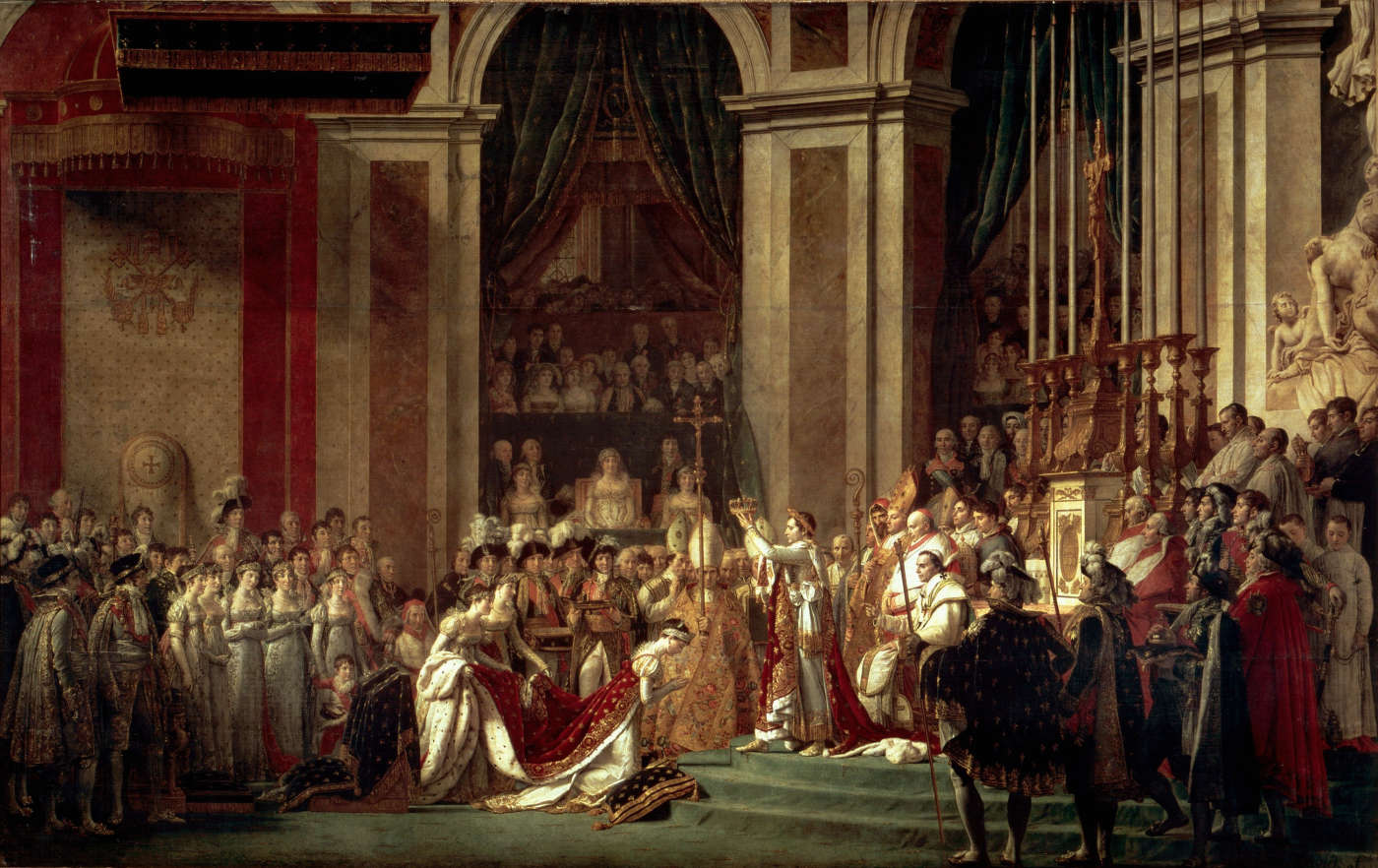
With his technique, Courbet steps outside Academic tradition. Look again at the painting, and see how the figures are crowded into the painting and how flat they seem, almost like cut-out figures, or a frieze. Until this art historical moment, the mark of a well-trained, worthy artist was his perfectly concealed brushstrokes and masterful depiction of deep space (see Jacques-Louis David’s coronation painting of Napoleon Bonaparte, 1805-07). By contrast the paint is loose and rough, almost as if Courbet wants people to see that it’s a farce – paint on canvas, rather than a peek into true reality. After Courbet, more artists – Manet, Cezanne, Monet, Picasso – began to experiment with the medium, breaking away from traditionally accepted subject matter and using color and texture freely, paving the way for what we call Modernism.